Ask three repair shops what a motherboard repair costs and you’ll get three non-answers: “depends on the fault”, “we’d have to look at it”, or a quote to replace the whole board. None of that helps when you’re trying to decide whether your laptop is worth saving.
So here is a straight answer, along with the thing almost nobody shows you: what the work actually involves, unedited, so you can see where the money goes. The short version — most common motherboard faults fall in the £90–£180 range, against £300–£600+ for a replacement board if one still exists for your model.
Why nobody quotes you a price up front
A motherboard repair isn’t one job. It’s a diagnosis followed by a repair, and the diagnosis is the part that takes the time.
Replacing a screen is predictable: the panel costs what it costs, and fitting it takes a known number of minutes. A motherboard is the opposite. The same symptom — dead, no power, not charging — can be a two-minute fix or a four-hour trace through the board’s power circuits. Until someone has actually put a multimeter on it, any number is a guess.
That’s why the honest process runs the other way round: diagnose first, quote second. You get told what’s wrong and what it costs before any work starts, and you decide from there. Go ahead with the repair and the diagnosis costs you nothing — the time spent finding the fault is absorbed into the job.
What a motherboard repair actually costs
Real figures, for a component-level repair rather than a board swap:
- £90–£180 — the majority of common faults: power rail failures, charging circuits, a single shorted component, liquid-damage cleanup on a board that’s still healthy underneath.
- Quoted individually — GPU and BGA reball work, and boards carrying several separate faults at once. These vary too much to price blind.
- £300–£600+ — what a replacement board costs, for the part alone, when one can still be sourced. For older or premium models, often nothing is available at any price.
That last line is the reason component-level repair exists. Once a laptop is a few years old, “we’ll replace the motherboard” frequently means “we can’t help you” — the board simply isn’t manufactured any more. Repairing the one you have is not the cheap option; it’s often the only option.
Watch where the time actually goes
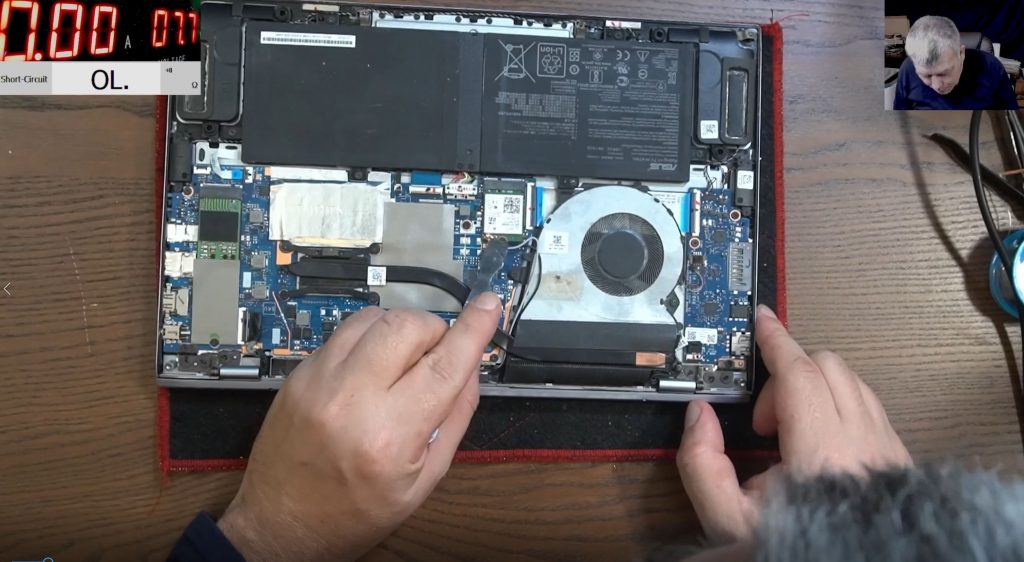
This is a full diagnosis on a laptop motherboard, recorded start to finish with nothing cut out. It runs 1 hour and 22 minutes, and that length is the point.
The board in that video came in booked for diagnosis. Here’s the sequence, and it’s the same sequence on almost every board:
- Read the board first. Before any measurement — what class of machine is this? A dedicated graphics chip, or an empty pad where one would sit? That single observation changes what’s likely to have failed and what a repair is worth.
- Measure current draw. How much current the board pulls on the bench says an enormous amount before a single component is touched.
- Hunt the short. Resistance to ground across the power circuits, capacitor by capacitor. In the video several capacitors read only a couple of ohms to ground — enough to know something is wrong, not enough to know what.
- Test the MOSFETs. Working through the power-stage transistors one by one, checking each channel, ruling them out.
- Draw the schematic. When the readings don’t add up, the circuit gets mapped by hand — coil to capacitor to ground — until the topology makes sense.
- Find the actual fault. On this board it was a dead Super I/O chip: the controller that reads the power button, talks to the keyboard, and communicates with the battery over its data lines.
- Work out why it died. Tracing back from the dead chip led to a broken battery connector — the clock and data lines running from the Super I/O down to the battery are the route that killed it.
That last step is what separates a repair from a parts swap. Replace the chip without understanding what killed it and the board comes back with the same fault.
The reason edited repair videos mislead you on price
There’s a moment in that video where Sorin explains why he refuses to edit them, and it’s the most useful thing in this article if you’re trying to judge a quote.
Cut a repair down to a tidy half-hour, and the viewer has no way to tell whether the job took thirty minutes or a full day. Customers then arrive having watched exactly that kind of video, saying “I checked YouTube, it looks like an easy job.” The editing removed the hours. He’s had jobs — long-screw damage on a phone board, rebuilding severed tracks — where people post a half-hour clip of what was genuinely a full day of microscope work.
So the unedited runtime isn’t self-indulgence. It’s the only honest way to show what you’re paying for, because on a motherboard you are paying for diagnostic time, not for parts. The component that finally gets replaced often costs pennies.
When a board isn’t worth repairing
Sometimes the answer is no, and you should expect to be told so:
- Multiple unrelated faults. One failure is a repair. Three separate failures on an old board usually isn’t economic.
- Physical damage across layers. A cracked CPU, or damage running through the inner layers of a multilayer board, can be genuinely beyond repair.
- The maths stops working. If the repair approaches what the machine is worth, that’s worth knowing before the work, not after.
An honest shop tells you this at the quote stage. That’s the whole purpose of diagnosing before quoting.
Getting a real price for your board
Generic ranges only go so far — your board needs looking at. The process here is deliberately low-risk:
- Diagnosis is free when you go ahead with the repair — the time spent finding the fault is absorbed into the job.
- A written quote before any work — you approve it, or you don’t.
- No fix, no fee — if it can’t be repaired you pay nothing for the work, just return postage.
- 90-day warranty on the work.
- UK-wide mail-in from the Grays, Essex workshop — component-level repair is specialist work and there may not be anyone local to you who does it.
Every board is repaired personally by Sorin — the same person doing the diagnosis in the video above, and teaching it to nearly half a million subscribers on the Electronics Repair School channel.
See how laptop motherboard repair works →
Post your laptop in from anywhere in the UK →
Common questions about motherboard repair cost
How much does laptop motherboard repair cost in the UK?
Most common faults — power rails, charging circuits, a single shorted component — fall in the £90–£180 range. GPU and BGA reball work, and boards with several separate faults, are quoted individually after diagnosis. A replacement board, where one still exists, is typically £300–£600+ for the part alone.
Is it cheaper to repair a motherboard or replace it?
Repair is almost always cheaper, and for older or premium laptops it’s frequently the only route — replacement boards for those models often can’t be sourced at any price.
Why can’t I get a price over the phone?
Because the same symptom can have completely different causes. Dead-and-not-charging might be one failed component or a fault traced through several circuits. Any number given before the board is measured is a guess, and guesses are how people end up with surprise bills.
Do you repair desktop and PC motherboards too?
The specialism is Windows laptop boards, where component-level work matters most — but desktop and other electronics boards are looked at as well. Send a message describing the fault and you’ll get an honest answer.
Do I have to pay for the diagnosis?
Not if you go ahead with the repair — in that case the diagnosis is free, because the time spent finding the fault is absorbed into the job. You always see a written quote before any work starts. If you decide not to proceed, a small charge covers the inspection time.
What if my motherboard can’t be repaired?
You’re told before any work starts. Under no fix, no fee you don’t pay for the work — return postage only.