Search “laptop repair” and the UK looks saturated: every town has a shop or two, every manufacturer runs a service line, and national chains sit on top of both. Yet “who can fix my laptop?” is still a genuinely hard question, because those businesses don’t all do the same job — and for the faults that matter most, very few of them can help at all.
The trade really splits into four tiers. Each one is good at something, and each one has a ceiling. What follows is an honest map of all four — what they fix well, where they stop, and which one suits the fault you actually have.
Tier 1: the manufacturer
If the laptop is under warranty, stop reading and use the warranty. A genuine fault costs you nothing, and letting anyone else open the machine first can put that cover at risk.
Out of warranty, manufacturer service changes character. It’s slow — the machine travels to a service centre and comes back in weeks, not days. And it’s replacement, not repair: service centres swap modules, so a fault anywhere on the motherboard means a new motherboard. That’s where the numbers turn ugly. A replacement board runs £300–£600+ for the part alone, before labour, and for older or premium models the board is often simply unavailable. “Uneconomical to repair” usually means exactly this: nobody looked for the actual fault — they priced a whole new board.
Tier 2: high-street chains and phone shops
The chains are the most visible laptop repair services in the UK, and for what they do, they’re genuinely fine: screens, batteries, keyboards, hinges, RAM and SSD upgrades, Windows reinstalls, virus removal. These are part-swap jobs using commodity parts, done quickly at sensible prices. Walking into one with a cracked screen is a perfectly good decision.
Their ceiling is the motherboard. Chains aren’t set up to diagnose circuits, so when a machine is dead the diagnosis stops at “it needs a new motherboard” — which is the manufacturer’s economics all over again. The Lenovo in the video below arrived with a job sheet that captures this perfectly: “charging port or motherboard” — the two parts a part-swapper could order. That diagnosis turned out to be half right and completely useless: the fault was on the motherboard, but fixing it meant one small chip, not a whole new board.
Tier 3: local independents
Independent shops are the widest tier and the hardest to judge. Some are excellent. Some are a counter, a screwdriver kit and an eBay account. The shopfront and the star rating won’t tell you which, because most reviews are for screen and battery jobs that any of them can handle.
One question sorts them instantly: “If it turns out to be a board fault, do you repair the board here, at component level — or replace it, or send it away?” All three answers are honest ones, and plenty of good independents send board work out to a specialist. But if your laptop is being posted to a specialist anyway, you can post it yourself and skip the mark-up and the extra wait.
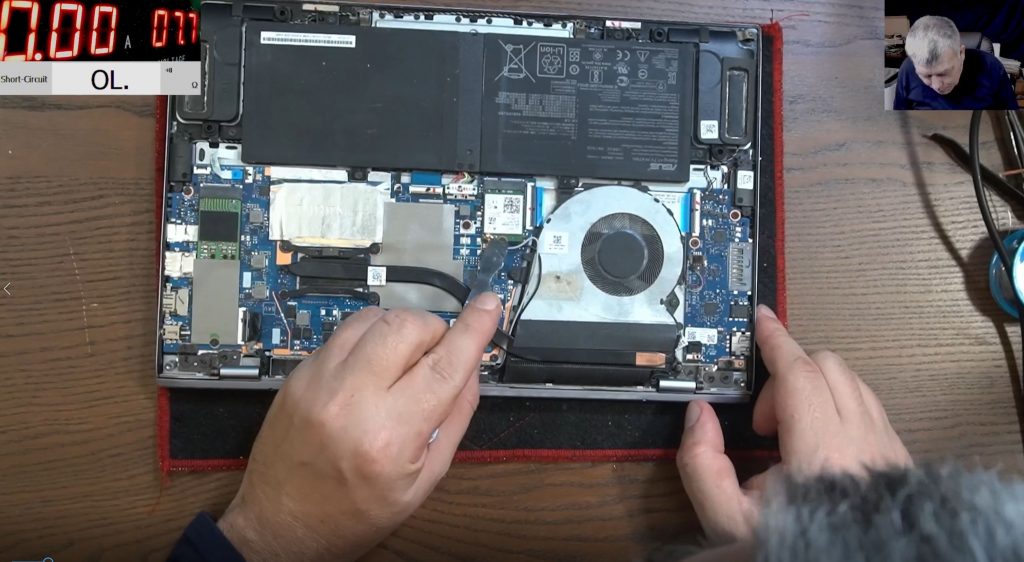
Here’s what that fourth tier looks like in practice — a dead Lenovo, no light, no charge, on the bench:
Tier 4: component-level laptop repair
The fourth tier treats the motherboard as a repairable circuit rather than a part number. It’s the only tier that repairs a dead board instead of replacing it, and the Lenovo above shows exactly what that difference looks like.
The machine arrived completely dead: charger plugged in, no orange light on the power button, a click from the button and nothing else — and, oddly, no model number printed anywhere on the case. First check, the charger: 20 volts on the multimeter, perfectly healthy. That was the first hole in the job sheet’s “charging port” theory. Next, main battery out, BIOS battery out, pins shorted to reset the BIOS — and the laptop stirred: orange light on, fan spinning, but nothing on the screen, a beep, and then a burning smell. Something on the board had let go.
Heat gives a fault away. The smell led to a small chip that supplies 5 volts to the USB ports, running far too hot — and right next to it, a physically broken USB port. Feeding that rail from a bench power supply confirmed the suspicion: the board pulled 300 milliamps while doing nothing, well beyond what an idle rail should draw. The chip was shorted internally.
With the failed chip off the board, the laptop came straight back to life — picture on the screen, fully working. The chip turned out to be a protection switch whose whole job is to cut USB power if a port shorts out; the port beside it was broken. And there was one last twist: this chip isn’t something you can simply order, so the replacement had to come off a donor board from a Samsung laptop.
That’s the tier difference in a single job. A part-level shop reads “dead laptop” and quotes a motherboard. Component-level diagnosis found one failed chip, and a “charging port or motherboard” job sheet became a working laptop — with the broken USB port itself noted as a separate, optional repair, because it wasn’t stopping the machine from running.
So who can fix my laptop? Match the fault to the tier
- Screen, battery, keyboard, upgrades, Windows problems — tier 2 or 3. This is part-swap territory, and a chain or any decent local shop handles it quickly and fairly.
- Anything at all, while under warranty — tier 1, every time. Don’t let anyone else open the machine first.
- Dead, not charging, no display, liquid damage, random shutdowns — board-fault territory, tier 4. Everyone else can only quote you a replacement board that may not even exist.
- Not sure? Ask the one question: “Do you repair motherboards in-house, at component level?” It sorts the entire industry in a sentence.
The economics justify being fussy about this. Most common motherboard faults repair for £90–£180; heavier jobs — GPU/BGA reball work, boards with several faults — are quoted individually. Set that against £300–£600+ for a replacement board, if one exists for your model at all.
No specialist near you? That’s what the post is for
Component-level repairers are rare — most UK towns don’t have one. That matters far less than it seems, because this tier runs on mail-in: the laptop travels, you don’t.
Here’s how it works at this workshop. Booking is 100% online. You post the laptop — any Windows laptop, any brand — from anywhere in the UK to the workshop in Grays, Essex. It goes on the bench for diagnosis, and you get a written quote before any work starts. Diagnosis is free when you go ahead with the repair, because the diagnostic time is absorbed into the job; if you decline the quote, a small charge covers the inspection time. And if a board genuinely can’t be saved, no fix, no fee — you pay nothing for the work, only return postage. Every repair carries a 90-day warranty.
Every board is diagnosed and repaired personally by Sorin — the Lenovo video above is his bench, and he teaches this work to nearly half a million subscribers on the Electronics Repair School YouTube channel. When a job sheet says “motherboard”, this is the tier where that word means repair instead of replace.
See what component-level repair actually involves →
Book online and post your laptop in from anywhere in the UK →
Related: What motherboard repair actually costs in the UK.
Who can fix my laptop — common questions
Who can fix a laptop that is completely dead?
A dead laptop is almost always a motherboard fault, and that puts it beyond the high street. Chains and manufacturers respond by replacing the board; a component-level specialist repairs it instead. On the Lenovo in this article, “dead” came down to one small 5-volt supply chip, run hot by a broken USB port.
Do high-street laptop repair shops fix motherboards?
No — and that isn’t a knock on them. They’re built for part-swap work — screens, batteries, keyboards, reinstalls, upgrades — and they do it well. Board faults get quoted as a full board replacement, which is expensive and, for older models, often impossible because the part is no longer available.
Is repairing a motherboard cheaper than replacing it?
Usually by a wide margin. Most common motherboard faults repair for £90–£180, while a replacement board is £300–£600+ for the part alone — and for older or premium models there’s often no board to buy at any price.
How do I find component-level laptop repair near me?
You probably won’t — the skill is rare enough that most of the UK has no local option. It doesn’t need to matter: this is mail-in work. Book online, post the laptop from anywhere in the UK, and it comes back repaired the same way.
What if my laptop turns out to be unrepairable?
Then no fix, no fee: you pay nothing for the work, only return postage. A small charge applies only in the different case where the machine is repairable and you decide not to go ahead with the written quote — that covers the inspection time.